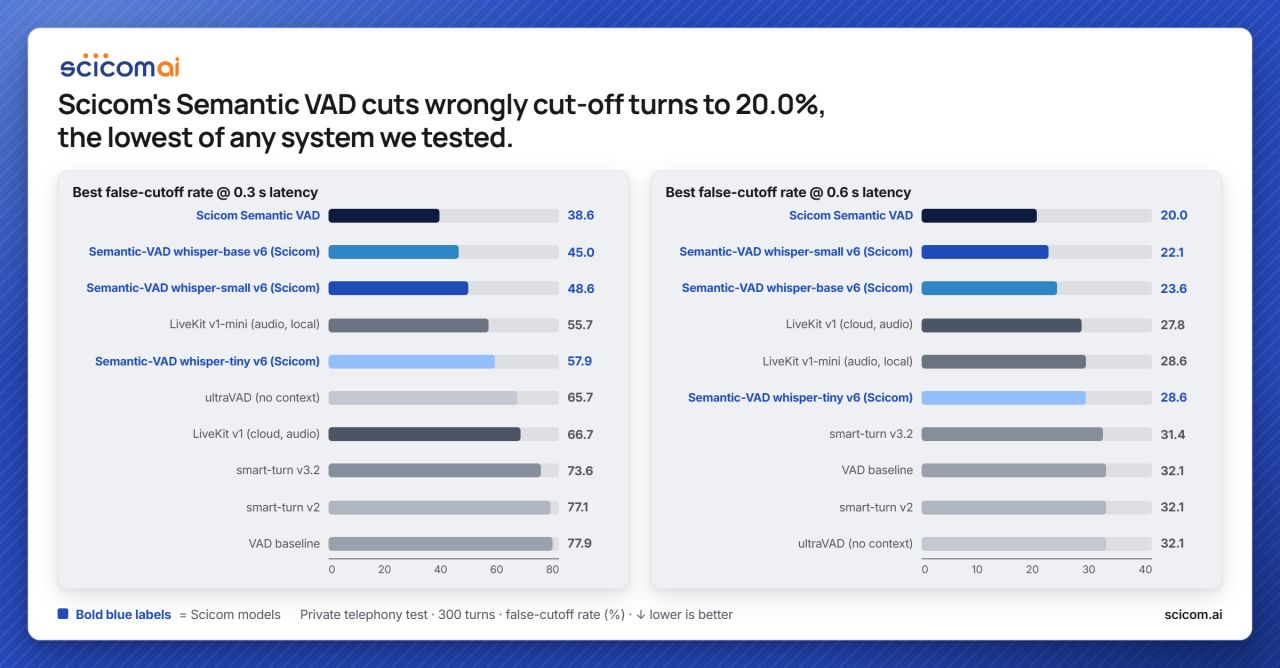
Semantic VAD cuts wrongly cut-off turns to 20.0%
False cutoff rate across ten end-of-turn systems at two latency budgets, measured over 300 real call turns on Malaysian telephony. The lowest of any system we tested, at both.
Getting cut off mid-sentence is the fastest way to make a voice agent feel broken. We measured how often it happens. 300 real call turns on Malaysian telephony.
The metric is false cutoff rate: how often a system cuts you off while you're still talking.
At 0.6s latency:
- Scicom Semantic VAD: 20.0%
- Next best: 27.8%
- Plain VAD baseline: 32.1%
At the harder 0.3s budget the gap widens: 38.6% for us against 55.7%.
We built this on LiveKit's open work on end of turn detection, and we have open sourced three of the models so you can run the comparison yourself.
Talk to us if you want to explore our frontier model.
First published on LinkedIn, 26 August 2026. The figures are reproduced as published; the test set is a private telephony corpus and is not redistributable.